Categories
Uncategorized

Behind the Label: Designing for Frank & Ray’s Coffee

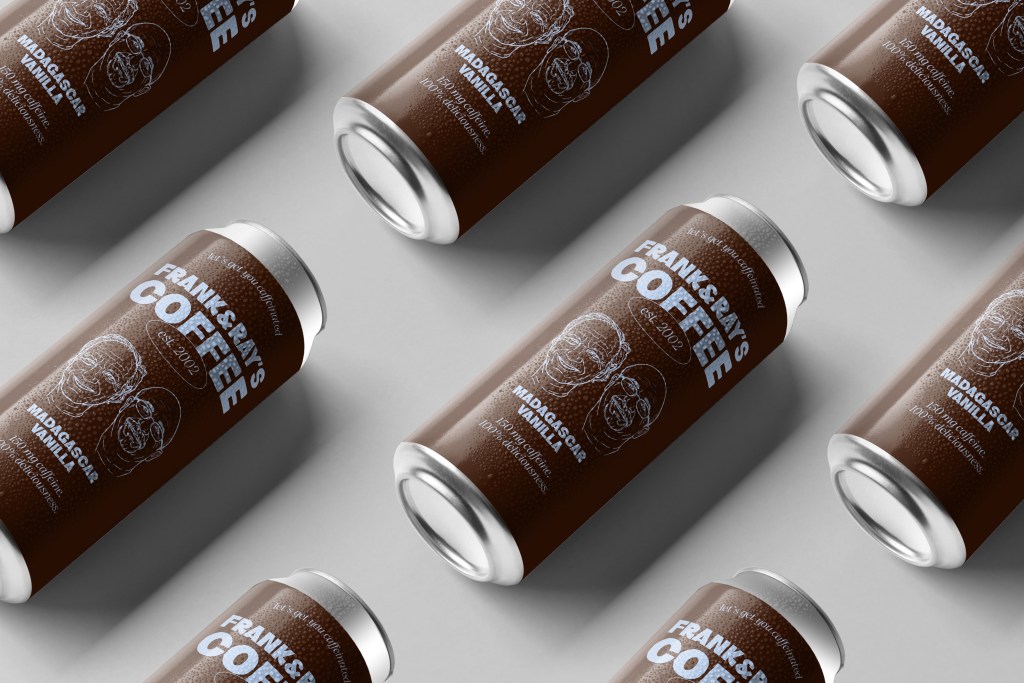
One of my favorite recent projects was designing can labels for Frank & Ray’s Coffee — a local craft coffee brand with a great product and an even better sense of humor names after my two grandfathers.

The Brief

The client wanted something warm, earthy, and approachable — with a nod to old-school Americana without being kitschy. They had a name, a personality, and not much else. That’s my favorite place to start.

Research & Moodboarding

Before touching any design tool, I build a visual language for the project. For Frank & Ray’s I pulled references from vintage coffee tin labels, craft beer packaging, and mid-century American commercial art.

Key themes: hand-drawn illustration elements, earthy browns and terracottas, bold condensed serif typography, and a worn texture that communicated heritage without feeling dated.

Typography

I landed on a condensed slab serif for the brand name — something with presence and warmth. Paired with a hand-lettered style for accent copy like “Small Batch” and “Single Origin” to add personality.

The Color System

The palette: deep espresso brown, warm terracotta, aged cream, and near-black for text. Each blend variant got a subtle color shift while keeping the system unified.

Final Deliverables

Print-ready PDF with bleed and crop marks, layered AI source file, web-optimized PNG, and a brand mini-guide covering color codes and fonts for future consistency.


Categories
Uncategorized

How I Edit Product Photos for Local Business Clients

Product photography doesn’t have to be complicated or expensive. Here’s a look inside my editing workflow — from Lightroom to final delivery — for local business clients.

Step 1 — The Shoot Setup

Before I open Lightroom, the foundation is set during the shoot. I rely on natural window light or a softbox for consistency. I shoot RAW, ISO as low as possible (usually 100–200), and aperture around f/8–f/11. Tripod always.

Step 2 — Culling in Lightroom

I cull ruthlessly. For a typical product shoot I might fire 200 frames and deliver 20–30 final images.

Step 3 — The Edit

My product edit is clean and consistent. I lift exposure slightly, set whites to the edge of clipping, pull blacks for depth, keep the temperature neutral-to-warm, and use HSL to boost the product’s primary color.

Step 4 — Batch Syncing

Once one hero image is edited, I sync those settings to all similar shots. Then I go back and tweak individually. This saves enormous time on large catalogs.

Step 5 — Export & Delivery

I deliver via shared Google Drive. For web: JPEG, sRGB, 2000px on the long edge. For print: TIFF or full-quality JPEG, Adobe RGB or CMYK depending on the print shop.

Categories
Uncategorized

5 Branding Mistakes Small Businesses Make (And How to Fix Them)

Your brand is more than a logo. It’s the font on your business card, the tone of your Instagram caption, the color on your storefront window. It’s the feeling someone gets when they encounter your business — and that feeling either builds trust or breaks it.

After working with small local businesses, I keep seeing the same five branding mistakes come up again and again. The good news? Every single one is fixable.

  1. Using Too Many Fonts

Pick two fonts and commit to them. One display font for headings, one clean font for body text. Keep them consistent everywhere your brand appears.

  1. Choosing Colors Without a System

A real brand palette has a primary color, a secondary color, a neutral, and an accent. Define your hex codes, write them down, and stick to them.

  1. Skipping Brand Guidelines

Even a one-page cheat sheet of your colors, fonts, and logo usage rules saves you hours of headaches later — especially when handing assets to a printer or social media manager.

  1. Using a DIY Logo Forever

A Canva logo is fine when starting out, but as you grow it starts to hold you back. When you’re ready to invest in your brand, invest in the logo first.

  1. Not Thinking About the Full Customer Experience

Branding touches every place a customer encounters your business — your email tone, your packaging, even how you answer the phone. Make sure it all feels consistent.